A vehicle health check is not a tick-list. Plenty of workshops run one that is, and then wonder why the authorisation rate is poor and customers query everything.
The difference is not thoroughness. It is evidence.
The problem with red, amber, green
A traffic-light list tells a customer your conclusion. It does not tell them why.
"Front brake pads: amber" asks someone to spend two hundred pounds on your word. Most people, most of the time, will say they will think about it. Not because they distrust you, but because they have been given a verdict with no way to evaluate it.
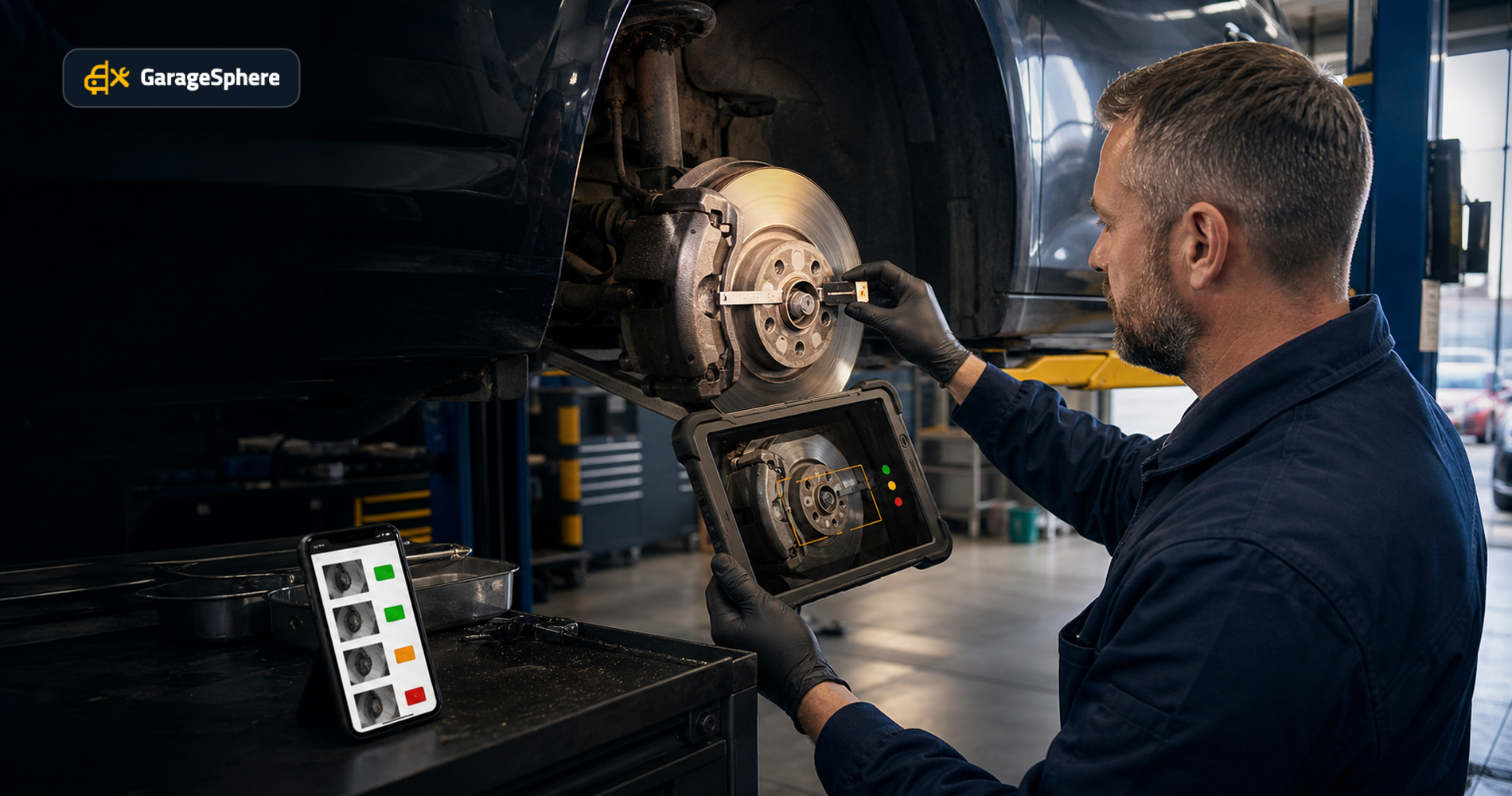
Now put a photograph next to it. Four millimetres of pad, measured, with the gauge in shot. Same conclusion. Completely different conversation, because the customer can see what you saw, and the decision moves from trusting a stranger to looking at a picture.
That is the entire mechanism, and everything below follows from it.
What a check should actually capture
A photograph of the thing itself. Not the car. The component. Close enough to see the wear, with something in frame for scale where scale matters.
A measurement where one exists. Pad thickness, tread depth, disc wear. A number is checkable and dateable, and next time the car is in, it tells you the rate of wear, which is the difference between "this will need doing" and "this will need doing before winter".
Video for anything that moves or makes a noise. Play in a joint, a knocking suspension, a belt squeal. A still photograph cannot carry it and a written description does not persuade anyone.
Plain language. "Nearside front lower arm bush perished" is accurate and means nothing to most people. "The rubber bush that stops the front wheel moving about has split. That is the knocking you can hear" means something. Write for the person paying.
A clear split between now and later. Not everything amber is urgent. If the customer cannot tell what is safety-critical from what is worth watching, they will treat it all the same way, usually by declining all of it.
The part most systems get wrong
The approval trail.
The customer says yes to two of the four items, on the phone, while you are holding a spanner. Later there is a disagreement about which two. Nobody wrote it down, because there was nothing to write it down on.
A health check that ends with a customer tapping approve on their own phone produces a record of what was authorised, by whom, and when. That record is worth as much as the photographs. It is the difference between an invoice you can stand behind and an argument you will probably concede.
It also removes the phone call, which is the slowest part of the whole process. A technician who has to stop and wait for someone to pick up loses the bay for twenty minutes.
What it does for the next visit
A check stored against the vehicle rather than the job is worth something a year later. Pads at four millimetres in March and two and a half the following March is a wear rate. It tells you what to expect at the next service, and it lets you have a conversation that starts "last year we measured this", which is a materially better conversation than starting from nothing.
This is why the check belongs with the vehicle's history and not in a folder of PDFs.
The honest summary
A digital vehicle health check sells more work than a paper one, and not because it is digital. It sells more work because a photograph is more persuasive than an opinion, a measurement is more persuasive than an adjective, and an approval the customer tapped themselves is not something anyone has to remember correctly.
If you are looking at digital VHC systems, judge them on those three things.
How long it should take
The objection is always time. A technician doing eight checks a day is not going to add fifteen minutes to each one.
They should not have to. A check done as part of the inspection: photographing what you are already looking at, on the device already in your hand: adds a couple of minutes. A check done afterwards, from memory, at a desk, adds fifteen and produces worse evidence.
If your checks take a long time, it is almost always because they are being done twice: once physically, once as paperwork. The second pass is the one to remove.
What to do about the ones that get declined
Most items will be declined, and that is not a failure. Somebody with a four-millimetre pad genuinely does not need it done today.
What matters is what happens to that record. A declined item that disappears is a lost opportunity twice over. You cannot follow it up, and next time the car is in you start from nothing.
A declined item stored against the vehicle is a conversation waiting to happen: "when you were in last March we measured these at four millimetres, they will be close to the limit now." That is not a sales pitch. It is a garage that was paying attention, which is rarer than it should be.
The follow-up matters more than the pitch. A customer who declines and then hears nothing assumes you were trying it on. A customer who declines and gets told when it is genuinely due assumes you were right.