Going paperless is usually sold on filing. Less storage, no lost job cards, everything searchable. All true, and all beside the point.
The thing that actually changes is where the job lives while the work is happening.
The walk to the office
Watch a technician on a paper job card for a morning and count the trips.
Vehicle comes in, card is written at the desk. Technician collects it, walks to the bay. Finds something not on the card: walks back to ask. Needs a part number: walks back to look it up. Finishes, writes on the card, walks back to hand it in. Someone types it into the system later, from handwriting, hours after the job.
None of those trips is long. Two minutes, maybe three. But there are six or eight of them a day per technician, and they are the most expensive minutes in the building, because they are billable hours spent walking.
Paper does not cause this. What causes it is that the job card is a physical object that can only be in one place, and the place it needs to be is wherever the person needing it happens to be standing.
What changes when the job is on a phone
The job stops being somewhere and starts being available.
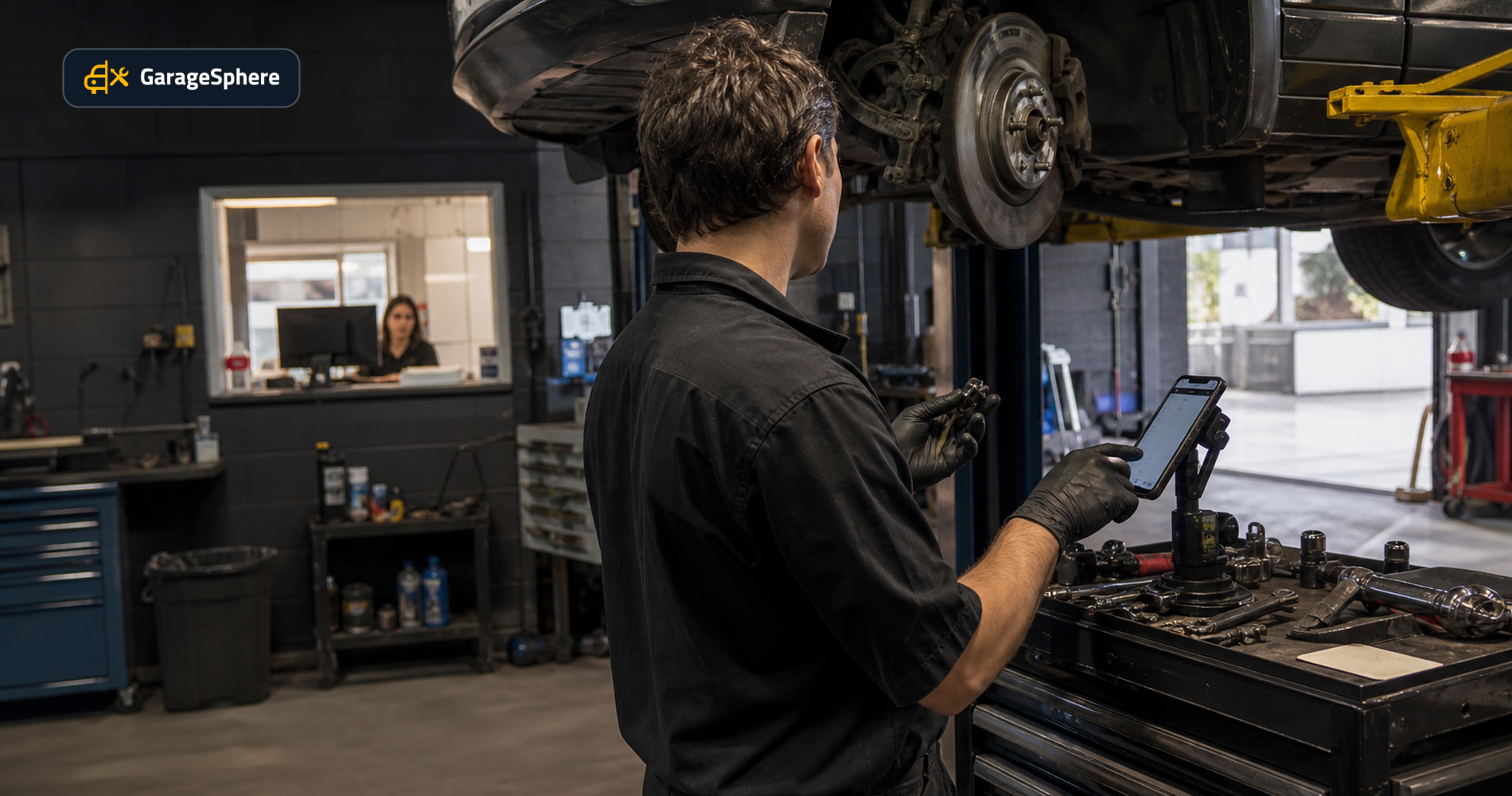
The technician finds a problem, photographs it, adds it to the job, from the bay. The front desk sees it appear without anyone telling them. The customer gets the health check while the car is still on the ramp. The parts get added at the point they are fitted rather than remembered at four o'clock.
That last one is where most of the money is. Parts recorded when fitted are parts that get invoiced. Parts remembered at the end of the day are parts that sometimes do not.
Our technician companion app exists for exactly this: the job in the hand of the person doing it.
What actually gets harder
Worth being honest about, because pretending otherwise is how these projects fail.
Typing on a phone is slower than writing. For a sentence, paper wins. The gain is not in the writing. It is in never re-keying it afterwards, and in the front desk seeing it immediately.
Not everyone wants to. A technician with twenty-five years of paper behind them is not being obstructive. They are being asked to be slower at something they are fast at, on a promise the benefit lands elsewhere. It usually does land, but it lands for the front desk first, and for them second.
Dead spots. Every workshop has one. Find it before it becomes an argument about whether the system works.
The transition is worse than either state. Running paper and digital together is slower than running either. Pick a date, move everything, accept a bad fortnight.
How to do it without a bad quarter
One thing first. Health checks are the usual starting point: contained, visibly better than paper, and the benefit is obvious to the technician because the customer says yes more often.
Let the first week be slow. It will be. Budget for it rather than being surprised.
Fix the dead spot before you start, not after somebody loses twenty minutes of work.
Show them the number. The argument that lands is not "it is more modern". It is "you did nine trips to the office yesterday". Technicians are not sentimental about paper; they are sceptical about change that has been sold to them before.
What it looks like when it has worked
Nobody walks to the office to ask a question. The board on the wall is a job board on a screen that is right, because it updates itself. Parts on the invoice match parts in the car. And the day's work is written up by the time the day's work is finished, because it was written up as it happened.
What to keep on paper
Not everything should move, and pretending otherwise loses people.
A note on a windscreen sticker about which key is which does not need a system. A whiteboard showing which bays are free is often faster to read across a workshop than a screen.
The test is whether the information needs to travel. If it stays in one place and one person uses it, paper is fine and often better. If it has to reach the front desk, the customer, the invoice or next year's technician, it should be digital, because those are the journeys where paper gets lost, copied wrongly, or never arrives.
Six months later
The change most garages report is not the one they expected. They expected to save time on filing. What they notice is that arguments stop.
Arguments about whether a customer authorised something. About which parts went on which car. About how long a job took. Those came from one root: a record written once, by hand, by one person, reconstructed later by someone else.
When the record is made at the moment the thing happens, by the person it happens to, there is much less to disagree about. That is worth more than the filing cabinet.