Most garage software will tell you it integrates with parts suppliers. That word covers several quite different things, and the differences decide whether the feature saves you time or just moves the typing somewhere else.
Worth knowing which one you are being sold.
Three things called "integration"
A catalogue copy. The software holds its own copy of the supplier's catalogue, refreshed periodically. You search it in the software. It is convenient, and it is only as accurate as the last refresh: stock levels especially, which move hourly.
A price lookup. You type the part number, the software asks the supplier what it costs. Better, but you still have to know the part number, which means you were looking at the catalogue somewhere else first.
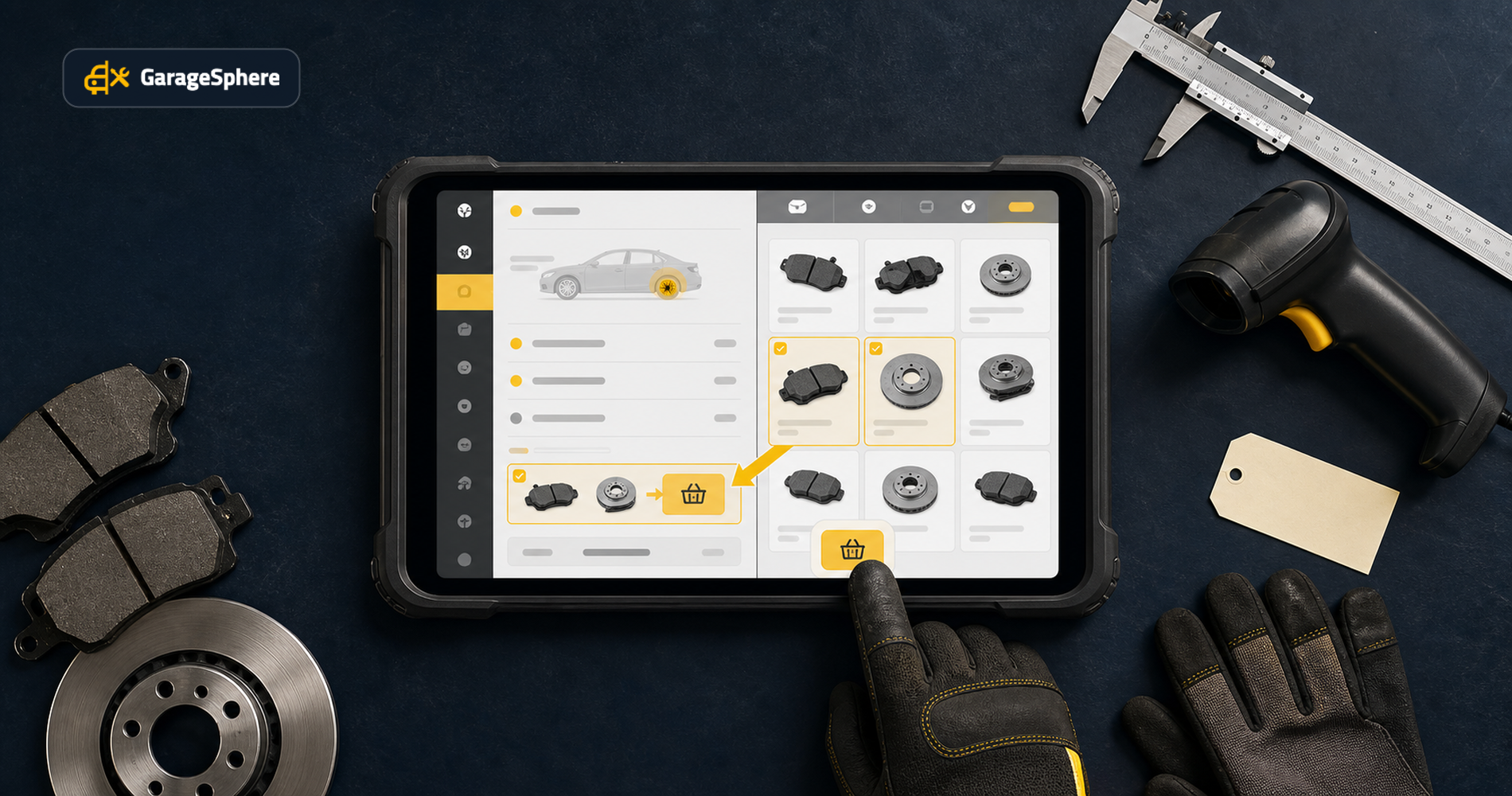
Punchout. You open the supplier's real catalogue from inside the job, use it, and the basket comes back as data. You get the supplier's own search, their live stock, your account pricing, and no typing at either end.
The third is the one worth having, and it is what the GSF Car Parts integration does.
Why "the price it was quoted at" matters
This is the detail that separates punchout done properly from punchout done approximately.
When a basket comes back, the parts can be priced two ways. Either the software takes the price the supplier quoted for that specific basket, or it takes the part numbers and looks up what they cost afterwards.
Those are usually the same number. When they are not: a promotion, an account-specific price, a change between the quote and the lookup: the second method quietly puts a different figure on the job than the one you were shown.
You find out at the end of the month, reconciling a supplier invoice against jobs, wondering why the margin is not what you priced.
A basket that arrives carrying its own prices does not have this problem. The number you were quoted is the number on the job, and the supplier's invoice matches.
What it removes from the day
Count the steps in the old way: open catalogue, search, note numbers, switch back, type numbers, type prices, check you typed them right.
Punchout is: open catalogue from job, search, add to basket, done.
On one job that is a couple of minutes. Across a workshop doing twenty jobs a day it is a person's afternoon, every week, and more importantly it removes the two places where errors get in, which are the part number and the price.
What to ask a supplier or a software vendor
If you are evaluating this, three questions get you most of the way:
- Is it the supplier's live catalogue, or a copy? Copies go stale, and stock is the first thing to go.
- Do the parts come back with the price they were quoted at, or is it looked up afterwards?
- Do they land on the job, or on a separate order I have to reconcile?
The answers tell you whether you are getting an integration or a slightly shorter walk to the same typing.
The objection worth taking seriously
The reasonable pushback is that a good parts person is fast, knows the catalogue, and does not make mistakes, so what is being saved?
Two things, and neither is about typing speed.
The knowledge stops being a single point of failure. When ordering runs through one person's head, the workshop runs at their pace and stops when they are on holiday. When it runs through the job, anyone can do it competently.
The record is a by-product. A fast parts person still has to write down what they ordered, for which job, at what price. With punchout that record exists because the ordering happened, not because someone maintained it afterwards. That is the difference between knowing what a job cost and reconstructing it.
Where it fits in the job
The sequence that works is: identify the work, then order against it.
A vehicle health check produces a list of what the car needs. The customer approves some of it. The approved items are what gets ordered, so the parts on the job match the work that was authorised, and the invoice matches both.
Ordering before authorisation is how workshops end up with parts nobody agreed to pay for, sitting on a shelf against a job that was declined.
What to watch after you turn it on
Whether parts are still being added by hand. If people carry on typing part numbers, the feature is not being used and it is worth finding out why. Usually it is habit; occasionally it is that the catalogue does not cover something they order often.
Whether supplier invoices reconcile more cleanly. This is the measurable one. If the prices on your jobs match the prices on the supplier's invoice without adjustment, the chain is working.
Whether anyone still keeps a parallel list. A spreadsheet that survives alongside the system is a sign the system is missing something the spreadsheet does.