Making Tax Digital gets treated as a filing requirement: something the accountant deals with at quarter end. It is more usefully understood as a requirement about record-keeping, and specifically about whether the numbers on a return can be traced back to the transactions that produced them.
For a workshop that mostly means one question: how does an invoice you raise become a figure HMRC sees?
What it is asking for
Broadly, MTD asks VAT-registered businesses to keep records digitally and to submit returns through compatible software rather than by typing figures into a form.
The part with teeth is the idea of a digital link. The chain from the transaction to the submitted figure is supposed to be digital end to end: data moving between systems as data, rather than a person reading a number off one screen and typing it into another.
Copy-and-paste and manual re-keying are precisely what the requirement is aimed at, because a re-keyed number is a number nobody can audit back to its source.
Where a garage usually breaks the chain
Not at the return. At the invoice.
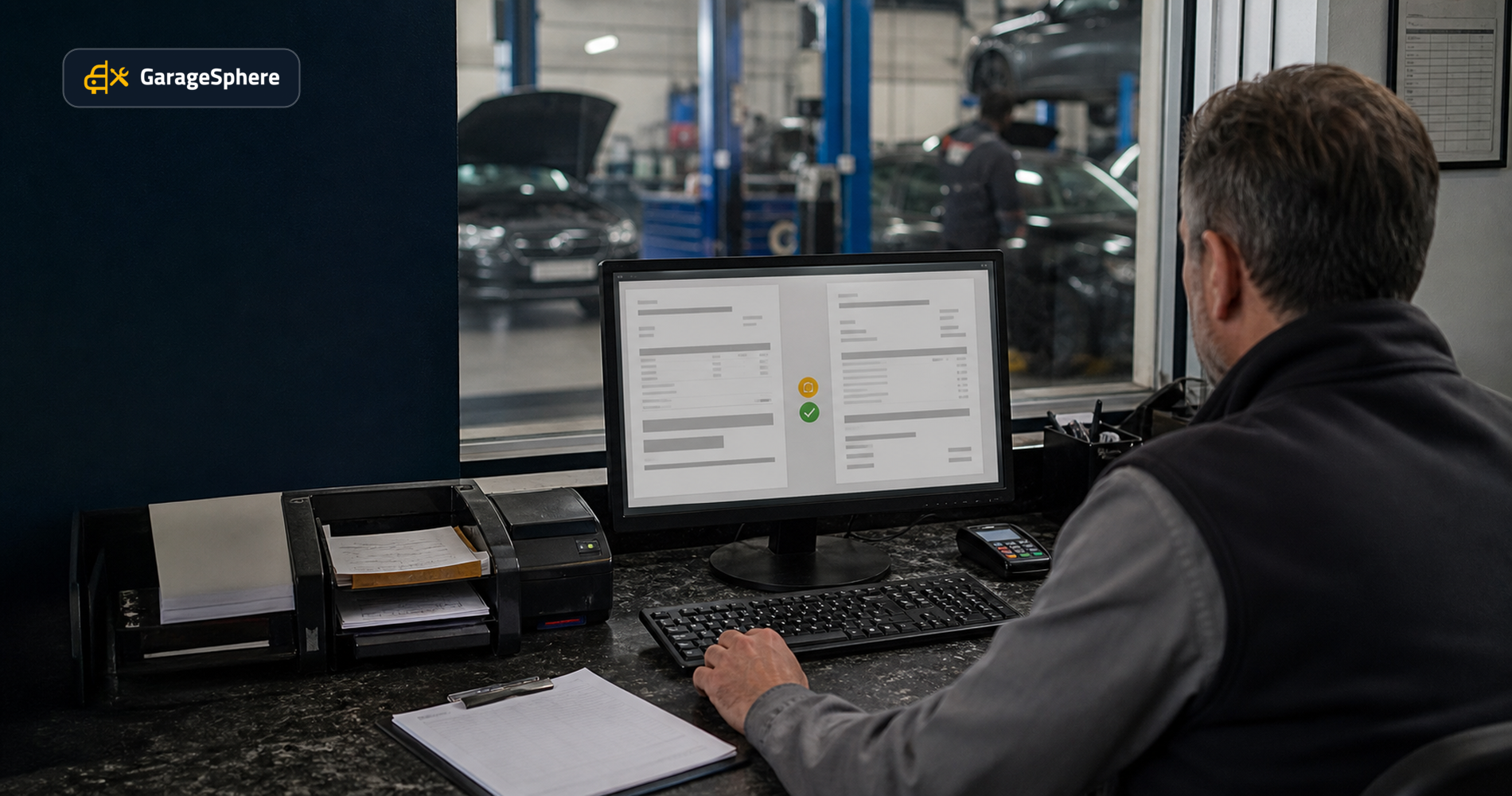
A workshop raises invoices in its garage system. The accounts live in Xero, Sage or QuickBooks. If somebody is re-typing invoice totals from one into the other: weekly, monthly, whenever there is time. That is the break. The rest of the chain can be immaculate and it will not matter.
It is also where errors get in, and they get in silently. A transposed figure, an invoice entered twice, a credit note that never made it across. None announce themselves.
What "in place" looks like
Invoices raised in one system, syncing to the accounts as data. Not exported to a spreadsheet and imported. Not read off a screen and typed. Our accounting integrations with Xero, Sage and QuickBooks exist for this: the invoice the workshop raised is the invoice the bookkeeper sees.
VAT applied at the point the invoice is raised, according to your settings, rather than worked out afterwards.
A traceable line from a job to a figure. Someone should be able to take a number on the return and get back to the job that produced it without a reconciliation exercise.
Purchases too. Supplier invoices are part of the same chain and are usually the messier half.
The practical benefit, separate from compliance
Even setting the obligation aside, this is worth doing.
A garage where invoices sync automatically knows what it has billed this month without waiting for anyone to catch up. Month end stops being a reconciliation exercise and becomes a review. The bookkeeper stops chasing missing paperwork.
Most garages that get their invoicing chain right report the same thing: they stopped finding out how the month went three weeks after it ended.
Where to check the current position
The rules, the thresholds, the dates and which businesses are in scope are all HMRC's, and they have changed several times and will change again. This article deliberately does not state them, because a garage acting on an out-of-date threshold it read on a software vendor's blog is exactly the failure worth avoiding.
Check HMRC's Making Tax Digital guidance for what currently applies to you, and take your accountant's view over anything written here.
What this article does claim is narrower and does not date: the chain from job to invoice to accounts should be digital, and re-keying is the link that breaks it.
Written August 2026. Check HMRC for the current requirements.